



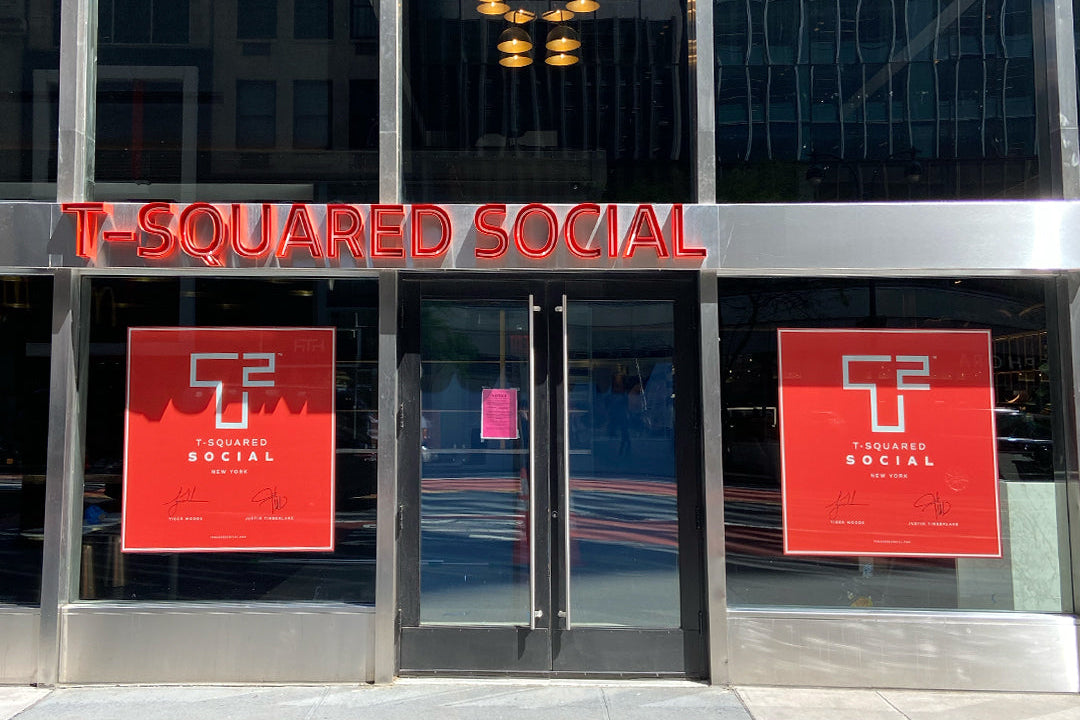

In forty years of producing flagship work out of our Chelsea, Hillside, and Miami studios, we've learned that retail and hospitality share the same problem: the first five seconds. A shopper steps off the sidewalk, a guest walks through the porte-cochère, and the brand either lands or it doesn't. What lands is almost always scale — handled properly.
Large format printing is how the best luxury retailers and hotels own those five seconds. It's the medium behind the windows, the walls, the columns, and the lobbies that people remember. The ones that don't land usually aren't failing because of the idea. They're failing because somewhere between the brief and the wall, the production broke down.
Here's how we see the work — five ways we've watched luxury retail and hospitality brands use large format printing to elevate their spaces, drawn from the floors we've actually produced it on. We serve luxury brand teams across every market we operate in, and the lessons below are the ones that keep coming back.
Key Takeaways
- The window and the lobby entry are the same surface — treat them as one.
- Luxury brand walls need to be produced like art, not like signage. The finish is the signal.
- Multi-location rollouts live or die on production discipline, not printing technology.
- One partner from file to wall beats six vendors every time — especially on launch calendars.
1. The Window & Lobby Entry Are One Surface
Most retail teams still think of the storefront as signage and the lobby entry as architecture. They're the same surface. Both are the first impression a brand gets to make, and both respond to the same treatment: floor-to-ceiling print, handled like a theatrical set.
The brands we produce for have mostly stopped treating window vinyls as a seasonal afterthought. A flagship window runs on a six-week cadence now — new imagery, new tension fabric, new backlit panels. A hotel porte-cochère wrap does the same job for a property that needs to be legible at forty yards in the rain. The materials are different — cast vinyl versus backlit fabric — but the thinking is the same: the outside surface is advertising space the brand already owns, and nobody else can buy it.
We've produced semi-transparent perforated windows that let daylight into the store while turning the glass into a billboard, and we've printed tension fabric systems that let a brand team change a storefront's entire façade overnight. Both count as window work, and both do more for foot traffic than most brand teams give them credit for.

2. Brand Walls Should Be Produced Like Art, Not Signage
The single biggest mistake we see in luxury retail and hospitality is a brand wall that's been produced to signage spec instead of art spec. A hotel lobby mural that reads as "print" from ten feet away tells a guest everything about how the brand sees itself. The ones that read as "art" do something else entirely.
The difference sits in the production stack. An art-grade wall means proper substrate (Dibond, Plexi face-mount, or museum-grade tension fabric), a color profile matched to a master proof, and a finish that doesn't go chalky under store lighting two months in. It also usually means the imagery gets framed and mounted the way a gallery piece would — our custom framing side of the house handles the oversized work that needs to live on a wall for a decade rather than a quarter.
When we produced brand photography for Louis Vuitton installations, we approached every piece the way we'd approach a museum-bound print. That standard isn't optional at the top end of luxury. The moment a guest can tell a lobby wall is "just print," the brand has already lost the room.
The other thing we've learned: the opportunities most brands overlook aren't the obvious walls. They're the columns, the soffits, the fixtures, and the ceilings. Print where nobody prints. That's where luxury brands build rooms people actually remember.

3. Launches & Activations Belong to the Print Partner
A product launch or a hotel activation is the clearest test of a production partner. The calendar is fixed, the scope keeps moving, and the brand team can't afford for any part of the stack to miss its window. We've run a lot of these. The pattern we see over and over: the launches that feel like events have one production partner doing everything, and the ones that feel like displays have six.
When we produced flagship launch moments for Tommy Hilfiger, the brand's team didn't need to manage nine vendors — they needed one team that could print, mount, ship, and install on a timeline the launch couldn't flex. That's not a scheduling preference. That's the actual difference between a launch that lives on Instagram and one that doesn't.
Activation work also lives or dies on material choice. Tension fabric because it goes up in hours without scaffold. Backlit because the activation runs into the evening. Mounted prints because the installation is going to live past the launch and move to a permanent wall afterward. The material decisions are the brand decisions. A good print partner makes them before the brief lands.
4. Multi-Location Rollouts Are a Production-Discipline Problem
Most of the failures we see on luxury rollouts aren't printing failures. They're discipline failures — color management that wasn't held tight across print runs weeks apart, substrate consistency that drifted between vendors in different cities, a proof that got signed off in one market and ignored in another. Version drift is the silent killer of a multi-location luxury program.
The fix is boring and expensive, which is why most programs don't get it right. It means running every job against a master proof. It means holding substrate specs exactly — not the closest thing a regional printer happens to have in stock. It means shipping finished work out of studios positioned in the markets that matter, rather than trucking it across three states.
That's why we built our studios in Chelsea, Hillside, and Miami where the luxury work actually happens. A flagship rollout across New York, New Jersey, and Florida shouldn't be a logistics problem. It should be a production problem — which is a problem we already know how to solve.
The question we wish more brand teams would ask a print partner isn't "can you produce this?" It's "can you produce it identically eighteen months from now, after four software updates and a substrate reformulation?" That's the real test, and most vendors can't answer it.

5. One Partner From File to Wall
The last thing — and the one we care about most — is consolidation. We've watched luxury brand teams juggle six vendors for one flagship install. Print from one. Mount from another. Crate from a third. Freight from a fourth. Install from a fifth. Post-install pack-out from a sixth. It doesn't work. The handoffs are where the project dies.
The production stack that actually works for flagship retail and hospitality is one partner handling substrate selection, print, mount, crate, ship, install, and pack-out under one project manager and one timeline. Our full production stack was built exactly this way — custom framing, fine art printing, mounting and lamination, and on-site installation all produced under one roof, by one team, on one invoice.
$9.11B in 2023 to $12.70B by 2030, and the growth isn't in hardware, it's in the production services surrounding the press (Grand View Research, 2024). But we didn't need a research report to tell us that. We've been running the integrated stack since 1983, because it was the only way to do flagship work properly even then.
If you're briefing a flagship rollout or a hotel activation for the back half of 2026, we'd love to hear about what you're working on. The earlier the conversation starts, the more the production stack can do for the final wall.
What Actually Separates Luxury Large Format
The short answer: the willingness to say no. Luxury-grade production means choosing a ten-year substrate for the install that's going to live on a flagship façade, and the discipline to refuse a calendered vinyl that won't hold up past two years. It means matching material life to install length, running every job against a master proof, and treating finish as a brand question rather than a specification.
The rest is execution. And execution is the part we've been doing for forty years.
Frequently Asked Questions
What is large format printing for retail and hospitality displays?
Large format printing covers anything produced above roughly 24 inches wide — window vinyls, tension fabric walls, backlit films, Dibond panels, Plexi face mounts, and oversized framed photography. For retail and hospitality, it's the production method behind flagship windows, hotel lobby walls, column wraps, event activations, and architectural brand graphics. At the luxury end, the best work is framed and mounted the way a gallery piece would be.
Which substrates last longest in retail and hotel spaces?
Cast vinyls and premium wrap films outlast calendered vinyls by a factor of three to five in vertical commercial installs. For permanent hotel lobby graphics and long-term flagship walls, mounted prints, tension fabric, and cast films are the defaults. Calendered vinyl is only acceptable when the program length matches the material life — which for most luxury work, it doesn't.
How far in advance should a flagship or hotel brief a print partner?
Four to six weeks is comfortable for a single-site flagship install. For a multi-location rollout across ten or more doors, eight to twelve weeks gives the production team the runway for proofing, color management, and coordinated install windows. Launches compress this — which is exactly why having a single production partner matters. Decisions that take a week in a vendor chain take a day in a single-team setup.
Can one partner handle rollouts across multiple cities?
Yes — and it's increasingly the standard for serious luxury brands. A production partner with studios in multiple markets can produce locally, install locally, and still hold one master proof and one project manager for the entire program. The alternative — six regional vendors — is where version drift starts and where most rollout failures come from.
What separates luxury-grade production from standard large format?
Three things: substrate selection, color management discipline, and the willingness to refuse a material that won't hold up. Luxury-grade production matches material life to install length, runs every job against a master proof, and treats finish as a brand question rather than a specification. The rest is execution.
Scale Is a Format, Not a Flex
The retail and hospitality brands winning the first five seconds aren't doing it with cleverness. They're doing it with scale, treated properly. Window vinyls, lobby walls, column wraps, rollout-grade reproduction — none of these are the point. The point is the brand environment they build together.
We've produced the work that lives on flagship walls and hotel lobbies for forty years.
Ready to elevate your retail or hospitality space?
Skyframe produces large format graphics, custom framing, and white-glove installation for flagship stores and hotels across NYC, NJ, and Miami — all in-house.
Get a Quote

